
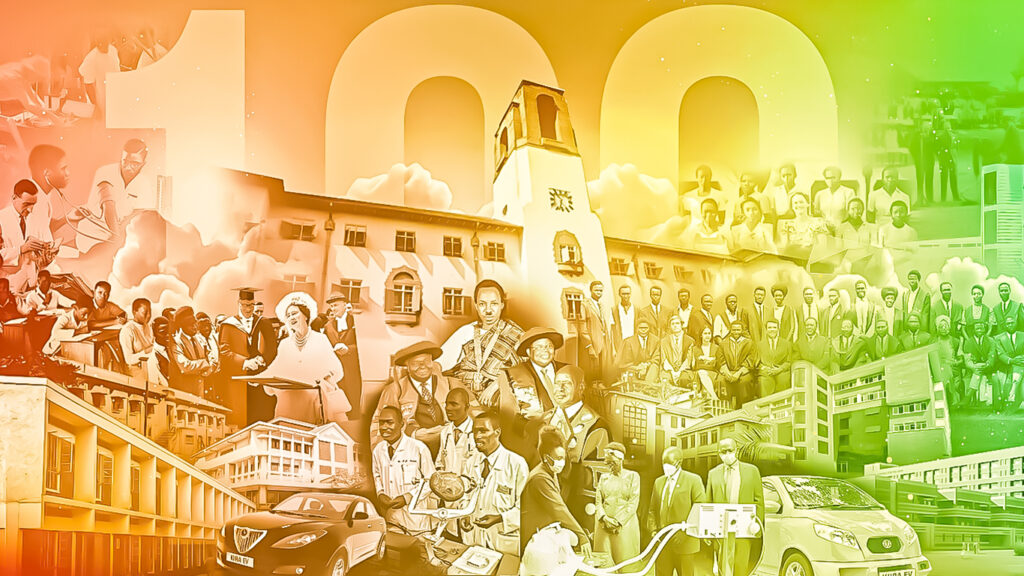
Keynote Address by Matthew Rukikaire
At the Celebration of Makerere University at 100 Years: A Legacy of Leadership
Theme: “A Legacy of Leadership”
I greet you all most warmly; it is good to be here this morning, and I thank you for giving me this opportunity to address such a distinguished group of people.
Today as we join in celebrating 100 years of Makerere University’s existence and we examine its former successes and failures, it is incumbent on us to also take a hard look at its present and future challenges.
More than sixty years ago Makerere, as an institution of higher learning, was the pride of East Africa and the envy of many African countries with similar institutions of learning. Exchange programmes with Makerere were sought after by American universities, countries in Africa were sending students to Makerere to obtain superior qualifications. The Medical School ranked as one of the best in Africa.
Though affiliated to London University, Makerere was a truly East African institution with student quotas shared between Kenya, Tanzania, and Uganda, and minor admissions from Northern Rhodesia (Zambia), Southern Rhodesia (Zimbabwe), Rwanda, and others. The intake of women was growing impressively and ahead of most universities in Africa.
Writers emerging from Makerere were among the best in the world, among them Okot p’Bitek, Lubadiri, Ngugi wa Thiong’o, and later, historians like Mutibwa, Karugire, and others.
Nor was Makerere lacking in scholarly distinctions such as Mwai Kibaki’s record of a First Class honors degree (London), earned in 1955.
Because of its East African character and its impact in the region, the question was being asked whether Makerere was driving or was riding the momentum of East Africa’s economic and political integration. In 1962, when I became President of the Students Guild at Makerere, I was elected with a big majority by an East African constituency. After my victory, we embarked on a campaign for East Africa’s integration, parallel to that conducted by East African leaders spear-headed by Mwalimu Julius Nyerere and Tom Mboya, among others. Makerere was experiencing or being affected by problems beginning to affect the effort of integration.
In 1961, Nyerere had boldly made an offer to other East African leaders and Britain, the colonial masters, to delay Tanganyika’s independence so that, together with Kenya and Uganda, they could simultaneously become independent and federate politically at the same time.
But political roadblocks emerged along the way. In Uganda, failure by Buganda to achieve full constitutional federal status in the London pre-independence negotiations, coupled with the “lost counties” issue, caused Buganda to resist an East African federation. They argued that if Buganda could not find acceptable accommodation in the Uganda constitutional framework, then they would be completely swallowed up in an East African federal set up.
Obote’s pre-independence position, though not in support of Buganda’s demands for full federal status was, paradoxically, in a similar situation. Uganda was seriously divided, was economically weaker compared to Kenya, and its political leadership position vis-à-vis that of Tanzania and Kenya was weak – a combination of these making Uganda’s expectations look untenable. So Obote pleaded for a delay in federating.
Kenya’s political landscape about federation was not much more encouraging. Kenya’s white settlers, led by the indomitable Bruce Mackenzie, later to become the first Minister of Agriculture in Kenyatta’s government and supported by Charles Njonjo, who became the powerful Minister of Constitutional Affairs, fought hard against the creation of an East African federation, in order to maintain Kenya’s agricultural and industrial dominance over its neighbours, and to prevent the spread of Nyerere’s African socialism in East Africa. Nyerere’s position of Tanzania was unambiguous. We federate immediately and work out the economic imbalances within the federation or abandon the federation project and each one goes their separate ways.
It was against the background of these developments in 1963 that the East African leaders gathered in Kampala at Makerere’s Main Hall to pronounce the breakaway of Makerere University College from London University and its transformation into an independent East African university; and, ironically, still calling for East African unity. Those at that historic conference were Milton Obote, Prime Minister of Uganda, Mwalimu Julius Nyerere, Prime Minister of Tanzania, and James Gichuru representing Jomo Kenyatta of Kenya. I was the fourth person sharing the platform with them, representing the students and Makerere as a whole. As you can imagine, I could hardly contain my excitement, at that age, of sharing the same platform with those East African leaders and speaking to the emerging nations of East Africa.
Having failed to move to full political integration, it was clear, as indeed Mwalimu Nyerere had indicated, that it was now a matter of time before the East African university broke up, like most other East African Common Services Organization (EACSO), into three national universities. In 1970, the University of Nairobi, Makerere University, and the University of Dar-es-Salaam were created.
Makerere was now on its own and was going through a rapidly changing political environment. Following the 1966 constitutional crisis, the attack on the Lubiri and the flight of the Kabaka of Buganda and President of Uganda into exile, the detention of five Ministers and, later, the enactment of the “Pigeonhole Constitution” with Obote becoming Executive President, the constitutional and political structures of Uganda had been totally overhauled.
Frank Kalimuzo had been appointed Vice Chancellor of Makerere University and, in 1972 was picked up from his official residence by Amin’s men and brutally slaughtered in Makindye military barracks. And so, as the historical current of the formation of East Africa run out, so were Makerere’s fortunes adversely affected; yet, mercifully, its star was one of those that remained shining in that dark night. As they say, stars shine brightest when the night is darkest. Makerere continued to shine in Uganda’s darkest hour.
Failure to move Uganda into an East African Federation leaves a mega question that perhaps posterity will continue to battle with, and that question is: “Would the tragedies that befell Uganda from the time of Independence till 1979 when Idi Amin was overthrown, and the subsequent confusion that reigned till the end of Obote II, have been avoided if the East African Federation had been realized, with Uganda as part of it?”
In spite of flight abroad for security reasons and to seek greener pastures by several academic staff, many stuck it out and bravely continued to hold fort at Makerere in a most insecure and hostile environment. To this day, more than 60 years after Uganda’s independence, Makerere continues to strive to regain its glory. Makerere’s ranking in Africa and the caliber of its research in various fields, such as agriculture, automotive industry, information technology, etc, speak for themselves. In this regard, I wish to commend and congratulate the Administration and teaching staff of Makerere University for accomplishing a mammoth task, even though a lot remains to be done.
There could not be a more fitting occasion than the 100th anniversary of Makerere’s existence to take stock of the past and to examine the challenges of the future. I want to thank you, Mr. Chancellor, Madame Chair of Council and Mr. Vice Chancellor, for bringing us together as past and present leaders of Makerere to celebrate the considerable success of Makerere, and also to consider the challenges of the moment and the years ahead.
You will note that, hitherto, I have dwelt on the history of Makerere in the context of East African integration which has occupied much of my life time. I pray that one day, even when I am no longer here, this integration will be realized. I do not want to be seen to be underrating the on-going efforts of the partner states to develop a customs union and other unifying measures such as East African identity documents – these are building blocks for an ultimate union.
Nonetheless, I believe passionately that Makerere, as the oldest institution of higher learning in East Africa, has a historical responsibility to be at the helm of advancing this integration process; it must continue to be the key institution in the processes of social change and development.
This becomes even more imperative in the context of today. Makerere must now confront new and daunting challenges not just of Uganda but of East Africa and, indeed, of Africa South of the Sahara.
Permit me to spend the next few minutes highlighting one important and pertinent issue of the time we are living with now – a subject that I find very intriguing, and that is the urgent challenge of Africa’s population.
Available population data shows that Africa is in the middle of what one demographer has called “the greatest demographic upheaval in history”.
According to researchers, by 2050 – only 27 years from now – the world’s population will be about 10 billion. Of that, Africa’s population is projected to reach 2.5 billion, or 25% of the entire world population.
Africa’s population will have grown eleven-fold in the century from 1950 – 2050.
By comparison, Asia in the same period will have grown four-fold; India alone, five-fold.
In 1950 Africa represented less than 10% of the world’s population while Greater Europe, for example, represented 20% of the world’s population. By 2050 however, Africa will represent 25% of the world’s population while Greater Europe will have shrunk to 7% of the world’s population.
Africa will contribute 65% of the global population growth between now and 2050. And it will still be growing strongly.
Twelve countries in particular are growing at the highest speed and will double their populations between now and 2050. These include Uganda, Tanzania, D.R. Congo, Nigeria, Niger, Angola, Cote d’Ivoire, Zambia, Mali, Chad, Mozambique, Burkina Faso and Burundi.
Nigeria for example will double its population from the current 200 million to 400 million in 2050. Uganda will also double its population from 45 million today to almost 90 million. Kenya will also almost double from 50 million today to 90 million by 2050, as will Tanzania.
If these figures are correct, Kenya, Tanzania and Uganda alone will have a population of 300 million.
Secondly, Africa today is also the youngest continent on the globe. The median age in Africa today is 19. In Asia it is 32. In Europe it is 44. In Uganda the median age is only 16. 60% of Africa’s population is under the age of 25.
By 2050, the populations of East Africa and West Africa will both be larger than Greater Europe (which includes Russia).
By 2050, 40% of the children being born in the world will be African. And one-third of the young people of the world (i.e. between 15 –24) will be African. Thirty eight out of forty of the youngest countries will be in Africa.
So what are the implications of this astounding phenomenon? This kind of population growth can either be a curse or a blessing, depending on how it is handled.
With the kind of population growth that Africa is witnessing, we can either become the largest slum, and the most politically unstable region of the world, afflicted by hunger, disease, war and massive migrations to other continents.
On the other hand, if Africa prepares her youth well, this population growth will spur massive economic growth, placing Africa among the powerful nations of the World.
As things stand today, 11 million African youth are being turned out into the labour market, but only 3 million new formal jobs are available for them, meaning that we already have a deficit of about 8 million.
How then can we in Africa ensure that we reap the demographic dividend? How can Africa tap into the potential of these young people to grow its economies at a faster rate than its populations are growing? How can Africa provide decent jobs, food, health care, housing and infrastructure for its youth?
We must think again.
In my opinion three things will matter the most:
1. EDUCATION: Education is probably the single most critical sector for the future of Africa. Africa’s youth must be educated and equipped with sufficient skills to navigate their way in the economies of the future.
We must ask ourselves: What curriculum changes are required in our education systems to prepare our young children to create the wealth needed to cater for this phenomenal growth in population? How can education be made more relevant to the economy?
2. REGIONAL INTEGRATION: We can say with confidence, that with this kind of population growth, no African country will be able to meet the demands of its youth by itself. Regional Integration of markets and economies, and even politics, is critical. If we integrate our countries and act together, it will be easier to achieve.
3. MACROECONOMIC STABILITY: African economies have grown over the last thirty years largely as a result of overcoming inflation by instilling fiscal discipline and maintaining macro-economic stability. A return to inflationary behavior and fiscal indiscipline would be disastrous for Africa’s economies. This discipline must be maintained.
The above projections must be qualified by two things which could happen: (i), if African countries adopted aggressive policies of population control, and (ii) if these countries discovered and exploited precious minerals and other resources of high value, they could nullify some of the negative impact of massive population growth.
The most important role universities have been assigned is the production of highly skilled manpower and research output to meet perceived targets. There is much need for reflection and action among scholars, and Makerere University would do well to take the lead in finding workable solutions in the coming two or three decades.
I want to make a bold proposal. I propose that Makerere as the oldest university in East Africa spearheads the search for and propose solutions to these problems by establishing a Centre to deal with the issues in the whole of Sub-Saharan Africa, covering economic integration, population and demography, environment and related technical training to support these efforts. We should conduct a campaign supported by East Africa’s leaders among all countries in Sub-Saharan Africa to support such a centre at Makerere.
I am sure that such a Centre would be able to attract global support and financing, because its impact and ramifications would be global.
Distinguished Ladies and Gentlemen, I thank you for listening to me. May Makerere continue to be a vital source of new knowledge and innovative thinking, and a powerful agent of social change.
May God continue to guide and uphold Makerere University and East Africa!