
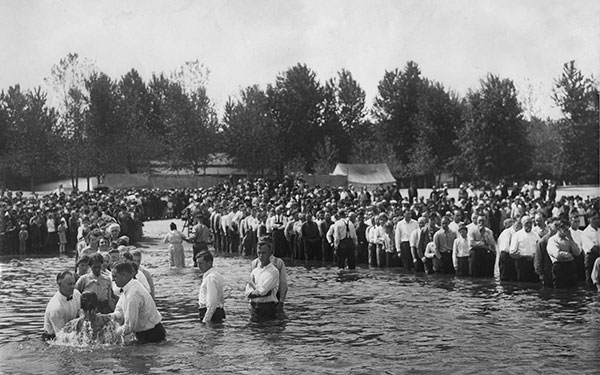
The Revival Movement may have been latent in the hearts of evangelical Christians and, indeed, in the masses at large, but it first exploded in a little-known hilly outpost called Gahini in Rwanda in the late 1920s, and early 1930s and quickly spread in the rest of Rwanda-Burundi, Kigezi in Uganda and on to the rest of Uganda, Kenya, Tanganyika, South Sudan and Congo. The early leaders of the Revival movement included Dr. Joe Edward Church, a British missionary, Simeon Nsibambi, William Nagenda, Yosiya Kinuka, Blasio Kigozi, Kosiya Shalita, and others.
It can safely be said that the seed of the Revival was planted by Joe Church and his association with the Keswick theological body, as a student at Cambridge University in the United Kingdom. The Keswick theology emphasized the post- conversion and baptism stage and a second spiritual elevation and blessing to another level of spiritual filling. After qualifying as a medical doctor, and through the Church Missionary Society (CMS), Joe Church headed for East Africa and his first spiritual contact was Simeon Nsibambi, already a born-again Christian himself; the two quickly bonded spiritually.
Dr. Church’s first commission was to Gahini where he started a hospital in 1928, and the first nucleus of the Revival adherents consisted of the hospital staff, where Kosiya Kinuka was already a staff member. Gahini quickly became the centre of the Revival movement and started attracting followers across East Africa during the early 1930s, creating its own momentum as it spread. It has been said that the movement became arguably the most famous African spiritual revival movement of the 20th Century.
My own father, the Rev. Canon Erinesti Nyabagabo, was meanwhile involved in the promotion of education in Kigezi, and together with Lawrence Barham, a British missionary, founded Kinyasano Primary School in 1927, and my father became its first Headmaster. At that school, he is remembered for having taught men who later became prominent in public service – men such as Filimoni Kitaburaza, Kosiya Kikira, Bishop Festo Kivengere, Rev. Yerimiya Betsimbire, Erica Bugari, Kezironi Kakuyo, and many others. He was then transferred to Kabale. From then onwards, North Kigezi became the strongest base of Revival in Kigezi.
When, in 1937, a team of Revivalists went from Kabale and held a convention in Rukungiri, Nyabagabo is remembered to have led a Boys Brigade band that accompanied the team and excited the people along the way. Among those who were converted during that time were Musa Bagyendera, Rev. Semu Ndimbirwe, Rev. Sam Katugugu, Canon Yerimiya Rwakatogoro, Rev. Erinesti Rutagarukayo, Rev. Tomasi Kakiza, and many others.
After a short spell as a teacher at the Normal School at Rugarama in Kabale, Erinesti Nyabagabo was selected to go to Gahini to be trained and ordained into the clergy hierarchy. He was therefore plunged into the heart of the revival and became part of it. Unlike other Ugandans ordained with him, who returned to Uganda to serve in their churches, Rev. Nyabagabo remained and served in churches in Rwanda and Burundi for years.
So as a child, I was able to witness, first hand, the fervor of the Revival at its height. A quote from the East African Revival by Brian Stanley illustrates this well:
“In May 1936 ecstatic signs began to appear in the Gahini district. Conviction of sin began to be accompanied by dreams, visions, falling down in trances, weeping, shaking and other phenomena of near hysteria. Hymn singing sessions went on all night.”
As children we attended conventions and witnessed such public repentance of sin, some of them of serious transgressions which sometimes led to break up of marriages and homes.
As I have stated in my autobiography, the impact of the Revival Movement created a fundamental change to African societies and cultures:
“The spirit of brotherhood among these early Christians was so strong that they no longer saw themselves in terms of tribe, or race, for that matter; they had conquered these barriers, miraculously. This extraordinary demonstration of oneness happened through the doctrine of the cleansing power of the blood of Jesus Christ, the Son of God; and since blood oaths were the most binding of covenants in African traditional beliefs, one can see how these early converts could relate to the covenant that was sealed by the blood of Jesus Christ.
And so it was the gospel of salvation through Christ that tore my father and thousands of other young people in Rwanda-Burundi, Kigezi, Ankole, Buganda and beyond, from their traditional bases and bound them into a new Christian fraternity. New men and women were created, with a new outlook and new values. This movement knew no geographical, ethnic, tribal or gender boundaries. The gospel was the biggest single socially unifying force, far surpassing the conquests of kings like Kabalega and Mwanga, or even the colonial conquests that created new African states. Evangelization was more pervasive because it was spiritual and knew no borders.” (70 Years a Witness – Matthew Rukikaire)